
As opera continues to evolve in response to cultural, technological, and societal shifts, BLO remains at the forefront, reimagining classic repertoire, integrating bold contemporary works, and making opera more accessible to everyone in our community. We love opera for where it’s been and where it’s going.
We’re just a few days away from closing Daughter of the Regiment, a fan-favorite opera that’s been given a Boston twist. Come ready to laugh and be dazzled by some serious vocal fireworks! Conducted by Kelly Kuo, directed by John de los Santos, with an energetic cast led by Brenda Rae (Marie) and Spencer Britten (Tonio), this production is sure to be a highlight of your weekend.
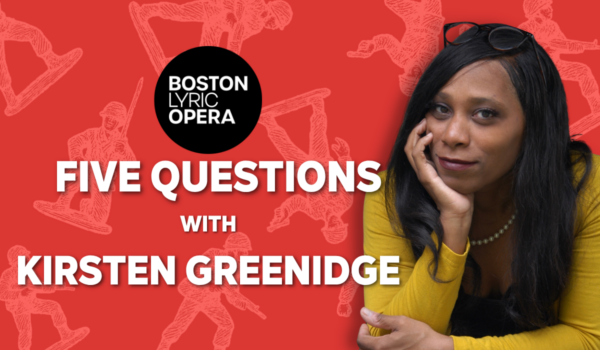
This month, we sat down with Kirsten Greenidge, who created the new English dialogue for Daughter of the Regiment, to hear about her vision and experiences as a writer working with opera, and why audiences should check out our upcoming production.
About Kirsten Greenidge
Village Voice/Obie and PEN America/Laura Pels winner Kirsten Greenidge is the author of The Luck of the Irish, Milk Like Sugar, Our Daughters Like Pillars and Common Ground: Revisited, an adaptation of J. Anthony Lucas’ Pulitzer Prize-winning book about Boston’s desegregation efforts in the 1970s. A hallmark of Greenidge’s work is her focus on the nexus of race, class, and gender in the U.S. Recent work includes Matilde: A Fable, last seen at the 2025 DNA Festival at La Jolla Playhouse; and her libretto adaptation for Boston Lyric Opera’s 2024 production of Joseph Bologne’s The Anonymous Lover, which was subsequently presented at Opera Philadelphia in winter 2025. Greenidge is an Associate Professor of theatre at the School of Theatre at Boston University, where she oversees the playwriting track of study and serves as the school’s director. She attended Wesleyan University and the Playwrights’ Workshop at the University of Iowa. She is currently working on commissions from Plays-in-Place, A.R.T., and Fourth Wall Theatricals, for which she is developing the musical Shelter, based on the journalism of Lauren Sandler, with music and lyrics by Crystal Monee Hall and direction by Lorin Latarro. Shelter will be workshopped at New York Stage and Film in summer 2025.
- What was your first opera?
My official answer would be Carmen. My more meandering answer is that at my grade school (Cambridge Friends here in Massachusetts), we had assemblies every Thursday morning and often students would write and perform their own operas. So my very first were those written by schoolmates.
- What made you want to take on a creative role in opera?
I was always jealous of those schoolmates and their operas, because I never wrote one. So, I suppose, one of the basest motivations there is: envy. Marrying story and voice and music in this way was captivating and something I have admired for a long time.
- In your experience as a writer, what is one of the most interesting intersections you have seen between opera and another
field?
The most obvious for me is the intersection of opera and theatre in terms of the power of live performance. There are very few spaces where we gather communally to witness and breathe – and in the case of some operas – laugh together, as humans.
- What or who were some of your inspirations for your adaptation of the libretto for Daughter of the Regiment?
I drew a lot of inspiration from the story of Deborah Sampson as a potential model for adapting Marie. My initial conversations with Nina and John included discussion of her role in the American Revolution as an enlisted member of the Continental Army, and how the revolutionary period could offer a rich space for our adaptation to root and grow. Also at the forefront of my mind was the literature that helped fuel the colonists and their leaders, particularly the work of Phillis Wheatley. Growing up in this area (Boston, Cambridge, Arlington, Lexington), I was taught a fair amount of colonial history in grade school, so much of my work involved revisiting that history and re-animating those spaces. It really is astounding to think that my route to high school included traveling the same road Paul Revere took (albeit in the opposite direction) as he spread word of the encroaching British troops in April 1775. As a child in Arlington, it was typical to come across monuments and stone markers commemorating the battles fought or the former dwellings of colonists who rose up in protest in the decades leading up to war. One of the annual field trips we took while I was at Cambridge Friends was to the Friends Meeting House on Brattle Street, which just so happens to sit across from the Vassall-Craigie-Longfellow House where Phillis Wheatley met George Washington after sending him her poem “To His Excellency George Washington.”
- Why should audiences come to Daughter of the Regiment?
It will be a marvelous time! There are many seemingly lofty reasons to come out to enjoy the arts, but the most important, I hope, is that it can be a lot of fun. John has created this fabulous landscape for all of us to play in, and when that happens, the most generous and enjoyable thing to be done is to share that with audiences.