
As opera continues to evolve in response to cultural, technological, and societal shifts, BLO remains at the forefront, reimagining classic repertoire, integrating bold contemporary works, and making opera more accessible to everyone in our community. We love opera for where it’s been and where it’s going.
We’re looking ahead to She Was There, a two-day event that brings together film, music, and dialogue to illuminate the often-overlooked stories of Black revolutionary women throughout history. Featuring a film screening curated by Roxbury International Film Festival, performances by BLO and Castle of Our Skins, and more at the West End Museum and Museum of African American History, this program asks: Whose stories have we remembered? Whose have we overlooked? And how do we honor the women whose presence changed history?
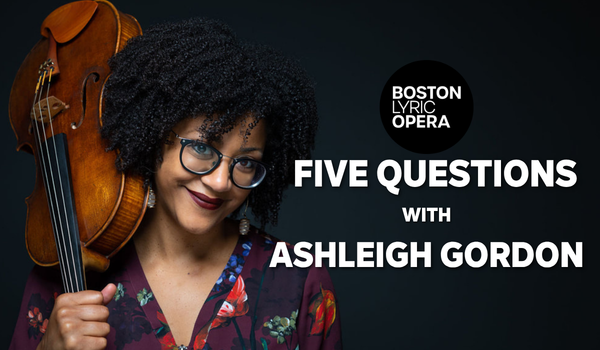
This month, we sat down with violist and Castle of Our Skins cofounder / artistic director Ashleigh Gordon to hear about her vision and experiences as a musician and arts leader, and why audiences should check out She Was There.
About Ashleigh Gordon
Ashleigh Gordon has recorded with Ensemble Proton and Ensemble Modern, performed with BMOP and A Far Cry, and appeared at the BBC Proms with the Chineke! Orchestra and at Carnegie Hall with Gateways Music Festival. She has performed internationally in venues like Royal Albert Hall, Konzerthaus Berlin, Oper Frankfurt, Dampfzentrale Bern, Centre Pompidou, and Lee Hysan Concert Hall. Gordon is cofounder, artistic director, and violist of Castle of Our Skins, a Boston-based concert and educational series devoted to celebrating Black artistry through music. She was awarded the 2016 Charles Walton Diversity Advocate Award from AFM and is a 2019 Brother Thomas Fellow. In 2020, she was nominated for the Americans for the Arts Johnson Fellowship for Artists Transforming Communities and named one of WBUR’s “ARTery 25.” She has presented lectures on citizen artistry and entrepreneurship, workshops for fellow educators, guest lectures, and frequently appears as a panelist discussing diversity in classical music. She is on the Board of Directors for Project STEP and serves on the Steering Committee for the Boston Cultural Leaders Coalition. Gordon is a graduate of New England Conservatory, Hochschule für Musik und Darstellende Kunst Frankfurt, and Baldwin Wallace University Conservatory of Music. For more information, visit www.violashe.com and www.castleskins.org.
- What was one of your first formative experiences as a musician?
I remember in high school attending an orchestra concert to see my violin teacher perform (yes, I started on violin before switching over to the dark side and becoming a violist!) My teacher was sitting third chair, first violin, and I had a prime location only a few rows from the edge of the stage to study her every move. The orchestra – the Rochester Philharmonic – was performing John Adams’ Short Ride in a Fast Machine. I remember being transfixed by what I saw and engulfed by what I heard. The music seemed to come to life before my eyes in technicolor fashion, the notes jumping in rapid fire from section to section. The musicians all seemed to be communicating telepathically and moving in synchronized lockstep. It looked like too much fun to not want to get involved! So from that moment on, I knew I wanted to be a professional musician.
- What were some of your inspirations for the themes of this concert?
A major inspiration for this program was Dr. Karen Cook Bell’s award-winning book Running from Bondage: Enslaved Women and Their Remarkable Fight for Freedom in Revolutionary America. Bell opened my eyes to a time period of American history that is frequently referenced in elementary schools across the country but so rarely told from a Black female lens. Through her work, I was able to learn of the many motivations that led Black women to take agency of their bodies, lives, families and futures. “Under the daily threat of bodily harm,” she noted, “[Black women] imagined the possibility of freedom and transformed that possibility into a lived reality. In doing so, they outsmarted those who sought to subjugate and belittle them. Fugitivity was a political act that changes what we know about Black women’s resistance.” She Was There explores the Black female perspective through an empowered lens – one of agency, ingenuity, love, fearlessness, and unwavering dedication.
- What is one of the most interesting intersections you have seen between classical music and another field?
I’m intrigued by musician colleagues I know who are deeply engaged in zoomusicology: the blend of zoology and musicology. Everything from building musical instruments for elephants to using sonar systems for underwater marine mammal communication – I think it’s fascinating!
- What is your vision for the future of Western classical music?
In order for there to be a future, I think the industry at large – everyone from the consumers to the practitioners to the critics and institutions that guide public narratives – needs to fully embrace the fact that our understanding of both the history and music yet to be created can evolve. That what we see as music (regardless of what genre we feel needs to be assigned), its application, presentation, and makers can and will grow, adapt, and expand.
- Why should audiences come to She Was There?
She Was There is a beautifully poetic tribute to fundamental factors that shaped this nation: life, liberty, and the pursuit of happiness. Told from an often unheralded vantage point, this program offers a glimpse into the psyche of powerful world builders, liberators, and resisters: Black women of the American Revolution and revolutionary Black women.