
As opera continues to evolve in response to cultural, technological, and societal shifts, BLO remains at the forefront, reimagining classic repertoire, integrating bold contemporary works, and making opera more accessible to everyone in our community. We love opera for where it’s been and where it’s going.
We’re looking ahead to She Was There, a two-day event that brings together film, music, and dialogue to illuminate the often-overlooked stories of Black revolutionary women throughout history. Featuring a film screening curated by Roxbury International Film Festival, performances by BLO and Castle of Our Skins, and more at the West End Museum and Museum of African American History, this program asks: Whose stories have we remembered? Whose have we overlooked? And how do we honor the women whose presence changed history?
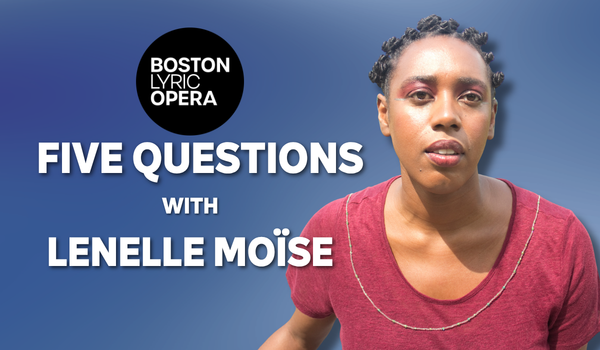
This month, we sat down with poet, playwright, and songwriter Lenelle Moïse to hear about her vision and experiences as an artist, and why audiences should check out She Was There.
About Lenelle Moïse
Lenelle Moïse is a poet, playwright, and songwriter. She wrote the romantic comedy K-I-S-S-I-N-G, winner of the 2023 Elliot Norton Award for Outstanding New Script, a national finalist for the 2024 Steinberg/American Theatre Critics Association New Play Award, and an international finalist for the 2024 Susan Smith Blackburn Prize. The full playscript of K-I-S-S-I-N-G is published in the Spring 2025 issue of American Theatre magazine. Moïse also wrote, composed, and co-starred in the critically acclaimed Off-Broadway play Expatriate. Her full-length script Merit won The Ruby Prize. An accomplished solo performer, she has been a guest artist at dozens of colleges and venues including the United Nations, Poets House, Lincoln Center, the Norton Museum of Art, and the International Museum of Women. Her book of poems, Haiti Glass (City Lights Books), won the PEN Oakland Josephine Miles Literary Award. She is currently working on WRIT RITM, a song cycle commissioned by the Huntington Theatre. Visit lenellemoise.com for more info.
- What was one of your first formative experiences as an artist?
When I was five years old, I wrote a poem on yellow legal paper. I handed it to my uncle, a poet (and my babysitter that day). He asked me to recite my poem aloud. Suddenly, the symbols on the page became sounds, and I realized that language is music. Today, I read my poems aloud as I edit. I practice reciting for hours, paying attention to musical elements like articulation, tempo, texture, and rhythm.
- You’ve written original poetry for this concert. What came up for you as you were exploring the repertoire and themes?
When Boston Lyric Opera and Castle of Our Skins invited me to write for She Was There, I jumped at the chance to learn more about the Black women who lived during the Age of Enlightenment. I felt curious: What were the Sisters feeling and doing in 1776? I was pleasantly shocked to learn that Elizabeth “Mumbet” Freeman, an enslaved midwife, successfully won her freedom in a Massachusetts court in 1781. That’s more than eighty years before the Emancipation Proclamation! It’s clear to me now that Freeman is one of the founding mamas of America. From our nation’s inception, Black women have been insisting on liberty and justice for all, overtly and covertly. It has been an honor to imagine and write about their inner lives and audacity.
- What is one of the most interesting intersections you have seen between classical music and another field? I’m remembering Disney’s Fantasia and Fantasia 2000. For me, these animated films were a fun introduction to Bach, Tchaikovsky, Stravinsky, and Gershwin. The fusion of orchestral music and visual storytelling delights me.
- What is your vision for the future of Western classical music?
Poets are vocalists! I hope to see more contemporary poets sharing the stage with classical musicians in grand halls with world-class acoustics. And personally, I would love to collaborate with an orchestrator to arrange my own songs for a musical ensemble.
- Why should audiences come to She Was There?
I am very excited for our concert on June 14 in Boston’s historic African Meeting House! Audiences will get to listen to vibrant music by living and legendary Black women composers. Responding to the music, I’ll be performing four new poems called “Elizabeth Freeman,” “On Children,” “Phillis Wheatley,” and “Cut Paper Silhouette.” Come through!